Board presentation deck
The strategic narrative: current challenges, customer voice, competitive position, and the path forward.
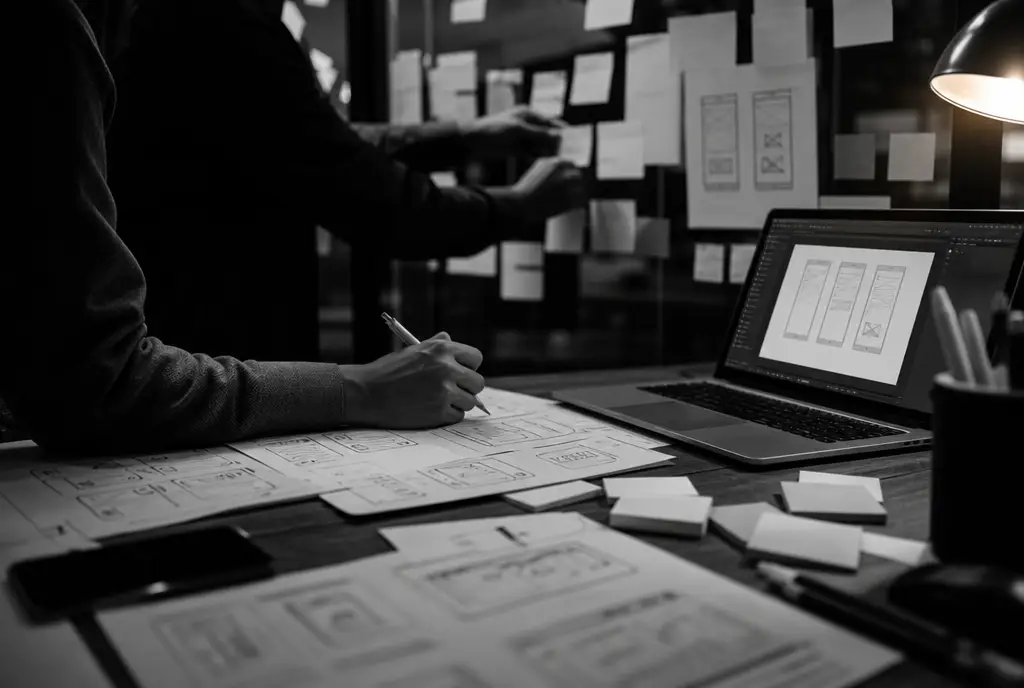
For the e-commerce performance platform, we turned scattered customer pain into a board-ready story: the honest current state, competitive benchmarks, redesigned product concepts, and a phased roadmap to get there.

The technology performed — the interface didn’t. Customers were saying it plainly, roadmaps were full, and the product team needed more than internal agreement: they needed board approval and investment to fund the fix.
That takes a story, not a backlog. Where the product stands, what customers actually experience, what competitors ship, and what the future state looks like — concretely enough to fund.
The brief: build the narrative and the visuals that move a board from “we know” to “approved.”
Customer quotes and UI snapshots came first, so nobody could wave the problem away. The board had to see it before it could fund the fix.
High-fidelity redesigns of the core surfaces — the Performance Advisor and Yobot — so the board could see the future instead of reading a backlog.
Sprint-level phases with milestones the board could track, backed by user stories the product team could execute the day after the vote.
The strategic narrative: current challenges, customer voice, competitive position, and the path forward.
Real customer quotes and UI snapshots, organized into an argument nobody could wave away.
Visual side-by-sides against the market — where the experience stood and what good looks like.
High-fidelity redesign visions for the core surfaces, including the Performance Advisor and Yobot.
Facelift first, deeper iterations after — sprint-level phases with milestones the board could track.
The user stories and acceptance criteria that turn a vision deck into a build plan.
Week one: review roadmaps, customer feedback, and current UI; storyboard the narrative with the product team. Week two: high-fidelity mockups, deck assembly, and iteration with stakeholders until the story held.
The deck did double duty by design — a boardroom narrative on top, and underneath it a tactical roadmap the product team could execute the day after the vote.
From kickoff to boardroom: review and storyboarding in week one, mockups and deck assembly in week two.
One narrative covering current challenges, customer voice, competitive position, and the path forward.
A phased UX roadmap, storyboards, user flows, and acceptance criteria the product team could execute right away.
It told the truth about where we were without burying us in it — and made the future state feel inevitable instead of expensive.Product leadership — Yottaa
Thirty minutes, no deck pitch. We walk your top three bottlenecks and what it would take to fix the first one.